 Star In A Star
Sidereal Time - a 3-part series
A sidereal clock gets its time from the position of faraway stars - not the Sun. Each 24 hour period all of the stars slide one-by-one across the meridian - each creating their own “noon.” There is a “Sirius noon” and a “Vega noon” and a noon for each of the thousands of visible stars. Some of the star “noons” happen at midnight, but some of them happen when the Sun is up.
The Sun is too bright; it blocks out the stars - let’s trick the Sun
But during the day even these bright stars are too dim to compete with the Sun. The stars are “up there” behind the Sun in the sky, but they cannot be seen: the Sun is too bright. During the day we cannot tell when a star crosses the meridian so we cannot tell sidereal time when the Sun is in the sky.
However, the Sun only blocks a sliver of the sky at any one time and we can use midnight to mark meridian star crossings. If we stay up all night, we can see most of the stars and those visible stars can be used as a sidereal clock; we just have to observe them. Let’s visualize the bright star Sirius lined up with the Sun on the meridian together.
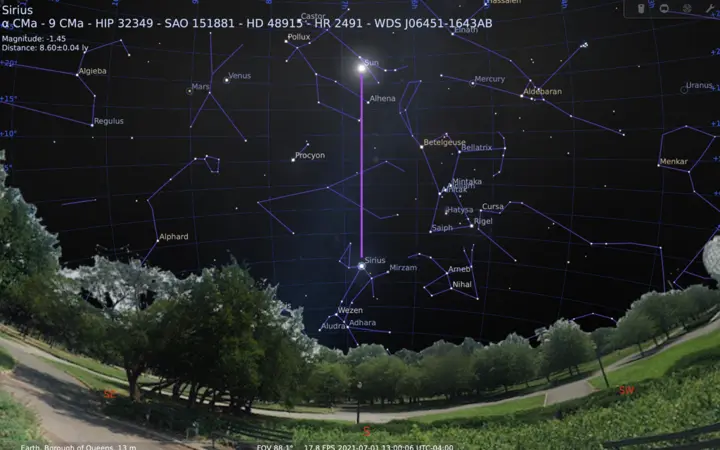 Sun and Sirius shown crossing the meridian at the same time in July. The purple line indicates the shared meridian. This image is what the sky will look like on July 1, 2021. It repeats every year the same way.
The Sun and Sirius, the Dog Star
This “lining up” of the star and the Sun means that Sirius noon and Solar noon happen at the same time. The Sun and the star travel together through the sky. Sirius is “there” closer to the southern horizon than the Sun. But it is invisible during the day because it is so much dimmer than the Sun. This almost perfect alignment of the Sun with the dog star Sirius happens on July 1st.
But, each day the stars “travel” a little bit faster than the Sun so they create a “star day” that is slightly shorter than a solar day. Star noons happen once every 23 hours, 56 minutes, and 4 seconds. This is 3 minutes and 56 seconds faster than the Sun. This “speed” difference makes the stars all appear to move faster than the Sun. So, each day the star Sirius moves slightly westward and precedes the Sun by a larger and larger slice of the sky.
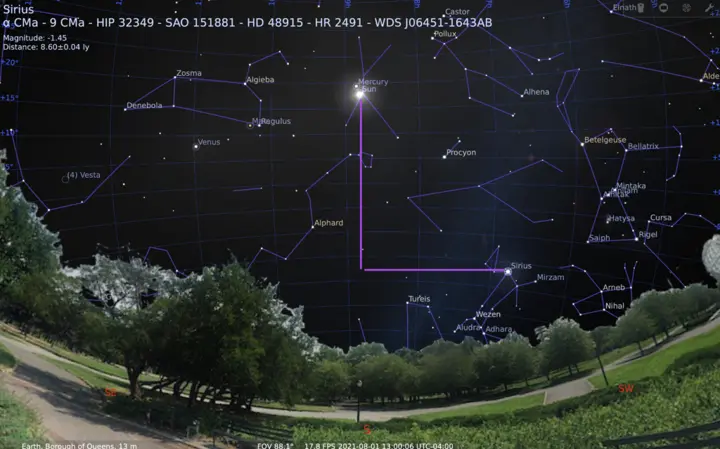 Sirius crosses the meridian before the Sun just a month later in August.
Larger slices of the sky
This means that, eventually, Sirius will spend more and more time in the night sky and its meridian crossings will become visible in the night sky. Sirius is seen first at dawn during heliacal rising in August and then later (by late fall) solidly in the dark sky of night. Eventually, Sirius will cross the anti-meridian (the opposite point to the Sun’s current meridian) at midnight and have its “star noon” (its meridian crossing) at solar midnight.
For Sirius, this happens at the New Year on December 31st around midnight. On this date Sirius is separated from the Sun by 180 degrees. At New Year’s Eve you are literally turning your back on the Sun when you look up at Sirius at midnight.
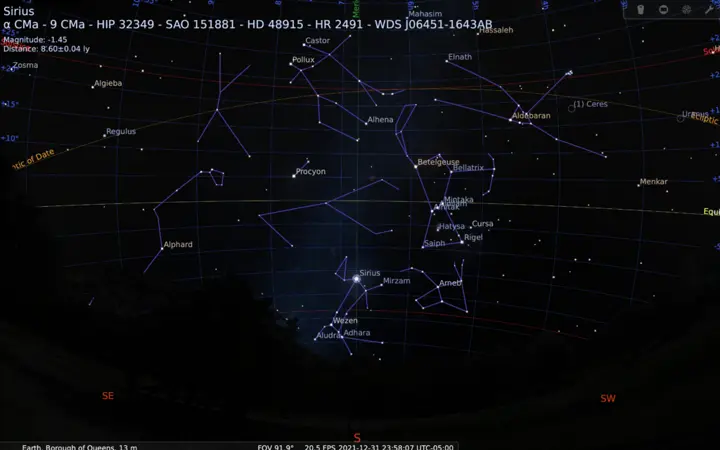 “Sirius noon” - on January 1st at midnight, Sirius has its own “noon” along with Mebsuta (ξ Gem) and Alzirr (ε Gem)
Which star is the main star? Which marks the start of the sidereal year?
To fully understand sidereal time, it helps to imagine you can see all the stars in the sky both night and day. Imagine being inside a giant celestial sphere. You look up, and you see the sky as if it is a giant, transparent shell.
Stars move across the sky during the course of a night and day, but they also move over the course of a year. Bright stars rise each minute, cross the meridian, and set. Each star crossing the meridian creates its own star noon. Once per year every star rises and sets together with the Sun. The stars can be thought of as a celestial sphere with the Earth at the center. But, there is no “main star” that marks the start of the sidereal year.
The celestial sphere is a map of the year
It’s fun to imagine sidereal time because it helps you to see the celestial sphere as a “map of the year.” Thinking in sidereal time helps you to see the Sun anew - a blinding light in the sky that hides the stars during the day and the source of “noon.”
By learning sidereal time you see that the Sun is independent from the stars, not moving with the celestial sphere but across it. Also, as a bonus, you can get more familiar with the words meridian (noon) and anti-meridian (midnight).
For instance, a star that first appears at the meridian at sunrise is a star that will join the Sun in 9 months. Every star moves westward day-by-day and it takes 12 months for the Sun to block out each one on its way through the sliver of stars in the Zodiac.
Now that you can see the celestial sphere as a map of the year, let’s step outside and learn how to see sidereal time in the night sky.
Previous: Star Noon and Sun Noon Next: See Sidereal Time in the Sky