 Star In A Star
Sidereal Time - a 3-part series
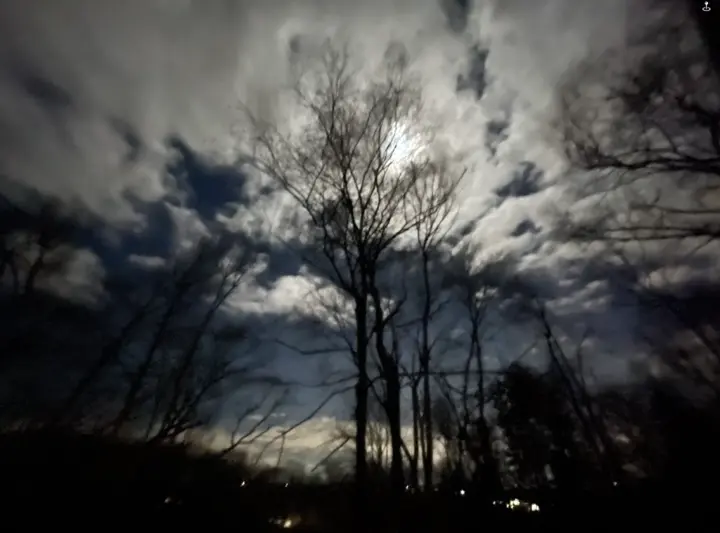
There are two skies: the sun (solar) sky and the starry (sidereal) sky. You can tell time by observing objects in both skies.
The Sun can be the basis for a clock; the stars can be the basis for a clock. Once a year solar clocks and sidereal clocks align with each other - telling the “same” time. This happens at the autumnal equinox, when the Sun’s right ascension is 12 hours. But, then stellar time and solar time drift apart.
Sidereal time is weird. Sidereal time (sai·dee·ree·uhl) means “star time.” Sidereal time-tracking challenges you to orient to the celestial sphere. It means you ignore the Sun and use the stars as your time keeper! You place the Sun inside the celestial sphere and see each layer of that placement as the foundation of a viable clock. Set a clock to “star time” (not solar time) and you’ll be a better astronomer.
Star noon
Star noon is a two word description of sidereal time.
Sun noon (solar noon) happens when the Sun crosses your meridian.
Star noon (stellar noon) happens when a star crosses your meridian.
There is only one solar noon but there are many, many stellar noons.
A star crossing the meridian can be said to be at “noon” in the sky. While “noon’ normally refers to the position of the Sun in the sky, we can say “star noon” as a shorthand for “star crossing the local meridian.”
Every star’s “noon” moves slowly around the 24 hour day through the year. A star’s “noon” happens near a solar noon once per year. If this seems confusing right now, don’t worry! We are going to look at stellar time more deeply and will see how the Sun and stars move (mostly) independently from each other.
Stars have their own “noon”
This is the concept of sidereal time: the stars have their own “noon” each day - but while the Sun’s noon (meridian crossing) is the noon, the stars have to make do with a shifting noon. This shift of the sidereal time happens because solar clock time is determined by the Sun’s apparent position in the sky, not any other stars.
If you track the sky by sidereal time, you have to observe the sky through the course of an entire year. The stars will appear in the same place the next day but you have to look up 3 minutes and 56 seconds earlier each day. This time shift happens because the Earth travels in its orbit. We get a slightly different “snapshot” of the sky each night.
Let’s first talk about how clocks work with the Sun so that we can understand how sidereal clocks work with stars.
The place named “noon” and the perfect clock
The perfect clock on the surface of the Earth precisely matches “clock noon” to the Sun’s meridian-crossing every day. But,* the perfect clock does not exist.* There is no clock that matches the ebbs and flows of natural time in all locations. For one thing, moving east or west on the surface of the Earth - even just at walking speed - changes the time. Also, in order to use a precise clock we also have to know the exact date.
But, let’s avoid complications and imagine that we have a perfect solar clock.
A clock is a machine tuned to the Sun
 Jean Housen, CC BY-SA 4.0, via Wikimedia Commons
A clock is a machine that is tuned to the Sun. A normal clock gets its time from the Sun. The moment the Sun crosses the meridian (an imaginary line that divides the eastern from the western the sky) we say it is noon. A normal clock’s noon (12 o’clock) coincides with this sky event.
Our clock time is set to match the way the Sun appears to move across the sky throughout the day (and night). When you say “same time tomorrow” it means “same Sun position tomorrow.”
A sidereal clock gets its time from the stars
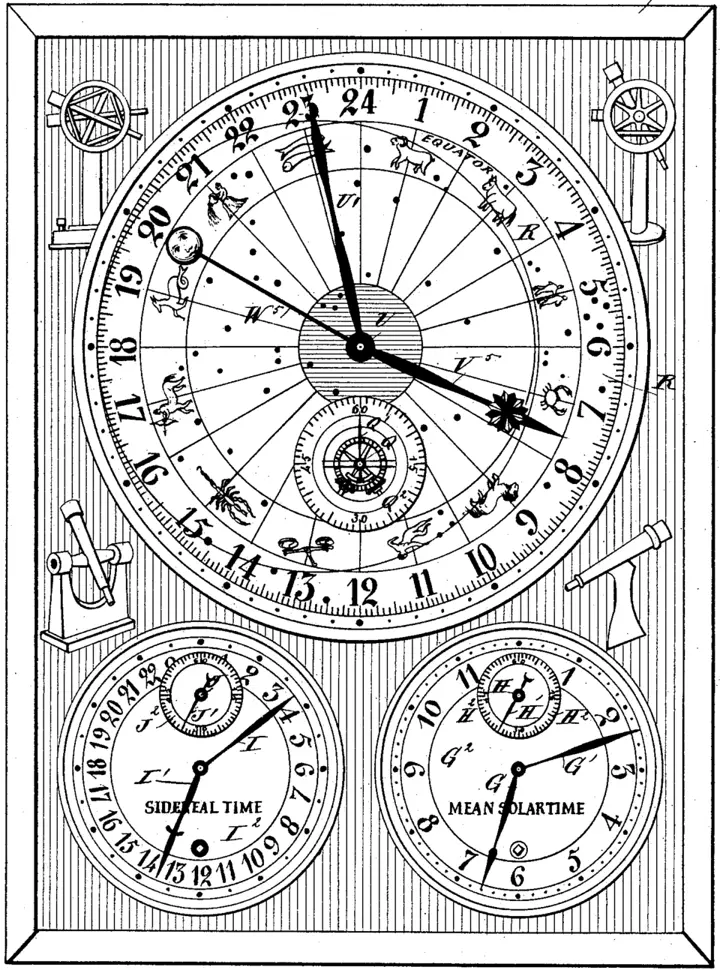 Sidereal Clock. Notice the Zodiac symbols around the top clock. Original from Wikipedia.

In contrast, sidereal time is set based on the way* stars* appear to move. That is a different reference frame because the stars arrive at the same place in the sky 3 minutes and 56 seconds earlier each day. If you said “see you the same sidereal time tomorrow” it would mean “let’s meet up about 4 minutes earlier tomorrow.”
The clocks based on the two sets of sky motions drift apart over the year and then meet again each autumn.
In the next post, we follow a single star — Sirius, the Dog Star — through the year, and see this drift play out in the real sky.
Next in series: Follow Sirius Through the Year