 Star In A Star
We are on lap 16.
Not us, personally, in our short human lifetimes, but the Earth beneath our feet, the Sun above our head, and the entire solar system. All of it is circling the center of the Milky Way Galaxy.
Scientists estimate that one full orbit takes about 230 million years. The Earth is roughly 4 billion years old. That means our planet has completed about 16 laps around the galaxy so far.
Sixteen trips around the galaxy.
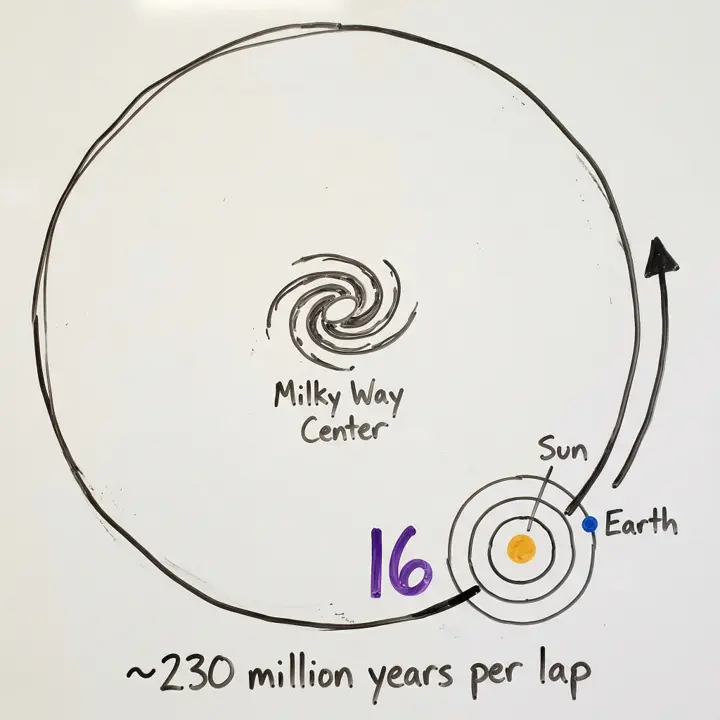 The solar system’s orbit around the Milky Way center. One full lap takes about 230 million years.
What does one lap look like?
It is hard to feel a galactic orbit. The Earth’s daily rotation takes 24 hours and we can see it in every sunrise. The yearly orbit around the Sun takes 365 days and we feel it in the seasons. But a galactic orbit? 230 million years is so long that the dinosaurs had not yet appeared when the Earth last crossed the spot where it is now.
Think about that for a moment. The last time the solar system was here, at this same position in its orbit around the galaxy, there were no T. rex, no flowering plants, no birds. The continents were in different places. The Atlantic Ocean did not exist. One full lap ago, the Earth was an almost unrecognizable place.
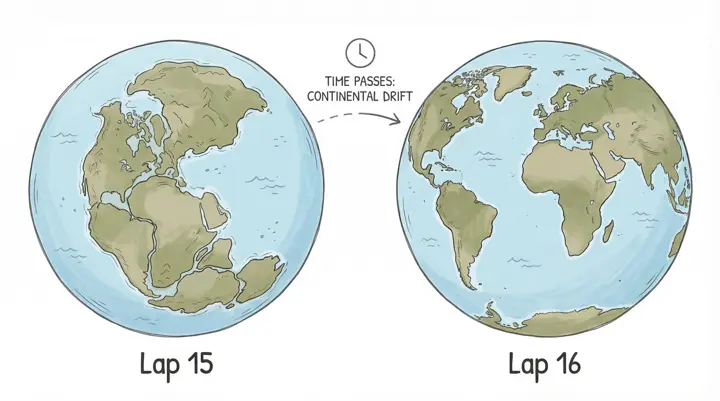 Earth one lap ago, with all the continents fused into Pangaea, and Earth today.
And yet, the orbit is real. The Sun moves through the galaxy at roughly 200 kilometers per second, carrying all of us with it. That is about 720,000 kilometers per hour. But the galaxy is so vast that even at that speed, one lap takes 230 million years.
What we are orbiting
At the center of the Milky Way sits a supermassive black hole called Sagittarius A*. It has the mass of about 4 million Suns packed into a region smaller than the orbit of Mercury. We cannot see it directly, but its gravity shapes everything around it. It is the anchor.
Sagittarius A* does not do this alone. The combined mass of all the stars, gas, and dust between us and the center contributes to the pull that holds the solar system in its orbit. But the black hole is the heavy center that the whole structure revolves around. Without it, the galaxy would not hold its spiral shape. The arms would drift apart. Our orbit would not exist.
We are 26,000 light-years from that center, moving along one of the spiral arms at 200 kilometers per second. Close enough to be held. Far enough to be safe. A comfortable distance for a 230-million-year lap.
Counting laps
At 4 laps per billion years, 4 billion years gives us about 16 completed laps. Sixteen times the Earth has traced this immense circle. Sixteen times the Sun has returned to roughly the same neighborhood in the galaxy.
Each lap, the Earth was different. On some early laps, there was no life at all. On later laps, the oceans filled with strange creatures. On recent laps, forests grew and fell and grew again, ice sheets advanced and retreated. On the most recent fraction of a lap, humans appeared, looked up, and started wondering about all of this.
20 more to go
Scientists estimate that the Sun will continue to shine for about 5 billion more years before it exhausts its fuel and swells into a red giant. Five billion years at 4 laps per billion gives us roughly 20 more galactic orbits.
Twenty more laps. That is what remains.
 16 laps completed, 20 to go.
We are not at the beginning and we are not near the end. The Earth is somewhere in the middle of its total journey around the galaxy, lap 16 of about 36. Not quite halfway.
There is something grounding about this. We live on a planet that has been around its galaxy many times and will go around many times more. We are not newcomers.
Next time you look up at the Milky Way — that faint band of light that is the edge-on view of our own galaxy — remember that you are not just looking at it. You are inside it, moving through it, rounding a curve that takes 230 million years to complete.
Lap 16. Twenty more to go.