 Star In A Star
Vega–Capella anchor stars
Bright stars can act as pointers to significant locations in space — places that have no star of their own, like the equinox points where the Sun crosses the celestial equator. You can’t see these points directly, but you can aim at them using stars you already know.
Observe the autumn equinox point in spring
Use Vega and Capella as “anchor stars” to help aim at the equinox points in the sky. When you can see both Vega and Capella low on the northern horizon, imagine a straight line between them. That Vega–Capella line is your baseline.
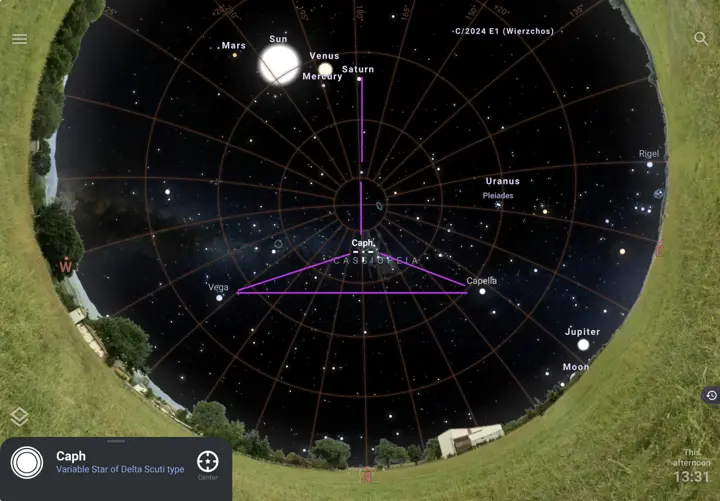
Add Caph (in Cassiopeia) as a third bright anchor. Using Caph + the Vega–Capella baseline, you can make a steady sight line that points toward the spring (vernal) equinox point.
Observe the spring equinox point in autumn
About six months later, use Phecda (in the Big Dipper) lined up toward Zavijava (in Virgo) as a strong marker for the fall (autumnal) equinox point.
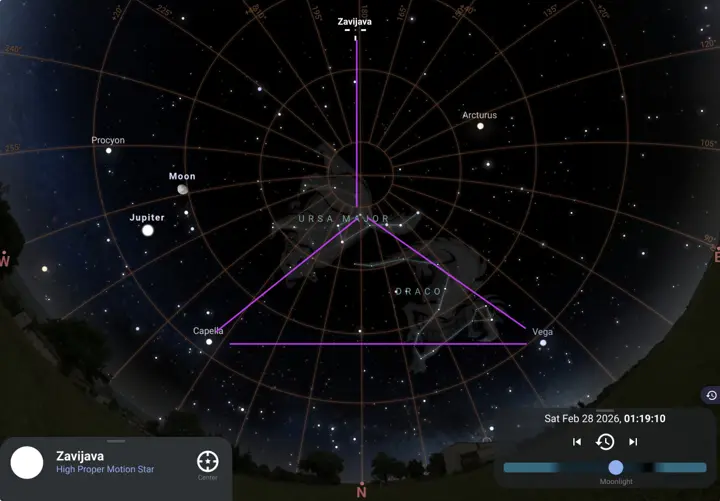
Note that as the Earth turns, Vega and Capella line up so their line looks almost parallel to the horizon twice each day, but you’ll usually only be able to see those moments at night.
Notes
- The equinox point is not a star. It’s a special spot in the sky.
- Do it when the stars are low in the same place each time to keep it consistent.